
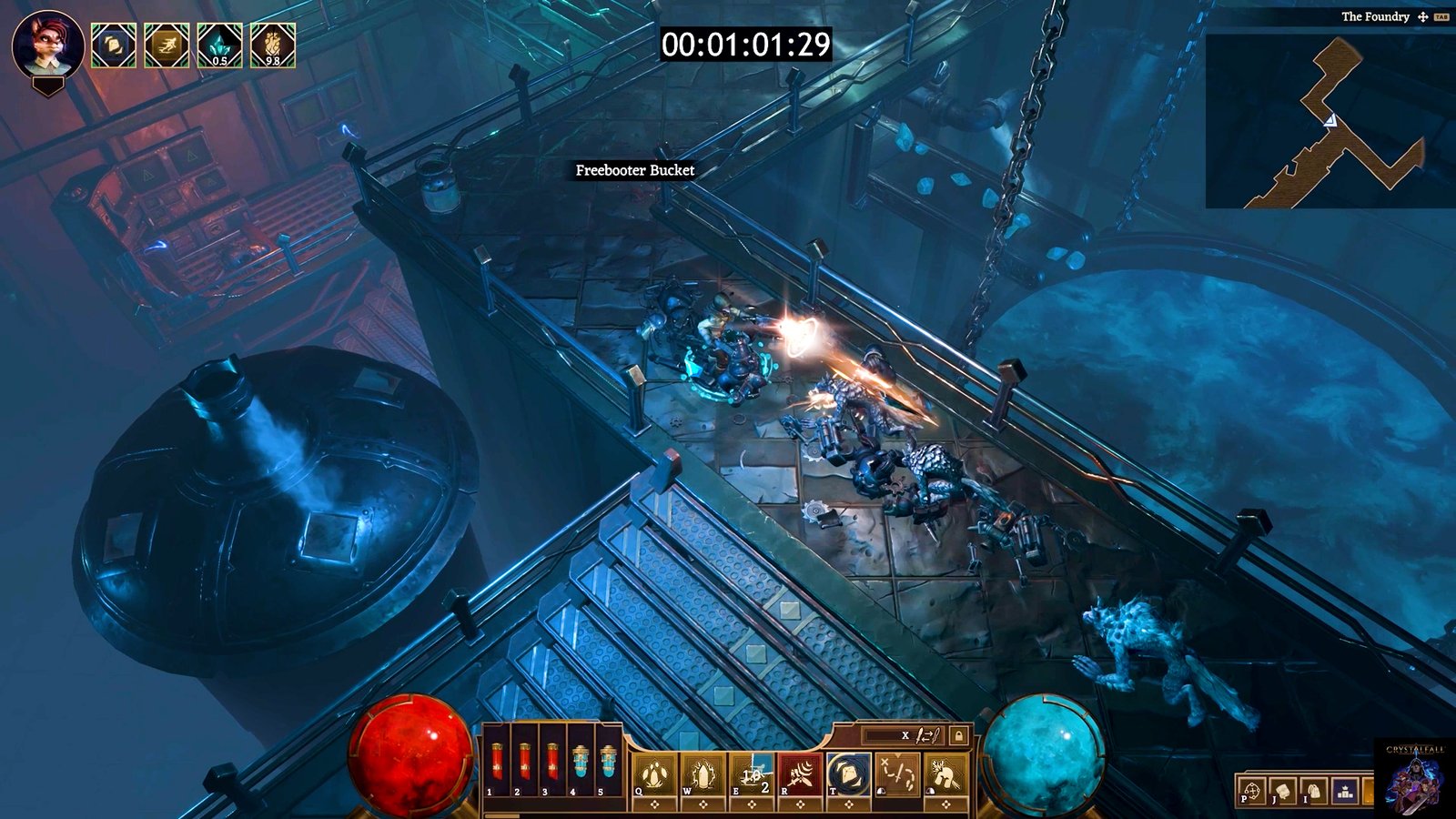
The popularity of the Diablo franchise, as well as titles like Path of Exile 2, have meant that isometric ARPGs are enjoying something of a Renaissance at the moment. Crystalfall, from new developer C.R.G Studio, is a brand new upcoming ARPG with a slick steampunk aesthetic and bags of personality. Releasing into early access in March, its looking to put its own stamp on the genre with some inventive build crafting and ambitious endgame plans.
I recently had the chance to interview C.R.G Studio’s game designers, Arvid Eriksson and Fredrik Larsson, to discuss Crystalfall in more detail. They told me some of the plans for early access and beyond, as well as some of the inspiration behind the game. As the studio’s maiden title, they also discussed the decision behind opting for a free-to-play model for Crystalfall. This interview has been edited for clarity and brevity.
Crystalfall is inspired by fan-favourite ARPGs
TGS: Crystalfall openly cites the likes of Diablo 2 and Path of Exile as some of its main inspirations. Were there specific parts of those games that you wanted to try and adapt?
”The point of the game is to go out, kill lots of monsters and get the cool stuff. So the core loop needs to be satisfying. Players will be slaying a lot of monsters!”
Arvid Eriksson: That’s a very interesting question. Diablo 2 is my personal favourite action RPG. And what I really like about it is that it’s really down to the dirty, gritty loot grind. It’s really about looting your items. It isn’t that much crafting orientated. That’s something I wanted to capture in Crystalfall, going a bit back to the basics of looting your items, like that’s at the core. We also have crafting, but it’s not as dominant as in Path of Exile. I would say its somewhere in between Diablo 2 and Last Epoch maybe in terms of how much crafting there is right now, at least at the point of early access. Obviously, there will be more crafting added as we add content, but we are not looking for the crafting element to dominate the game. You kill the mob, you find the loot, you get happy.
Fredrik Larsson: And then extending on that, it’s the traditional hack and slash combat. The point of the game is to go out, kill lots of monsters and get the cool stuff. So the core loop needs to be satisfying. Players will be slaying a lot of monsters! I’d say we are a bit slower than Path of Exile, but probably a bit faster than Diablo 2 in our combat as well. We’re sort of positioning ourselves in the middle there, at least for now. You can of course play slower builds if you want, but you can also play faster builds, sacrificing maybe defences for speed. It’s always an option.
TGS: When you look at the ARPG genre today, do you feel that there was something that’s either missing in the genre or something that perhaps is being overdone in the genre? Have you spotted a gap where Crystalfall would fit nicely into?
Eriksson: Yes. I think there is way too much dark fantasy slop, there isn’t a whole lot of thought behind it. It’s just things mashed together. You know, we wanted to give it a bit more style, lean a bit more into steampunk, a bit more into airships and do a bit of our own world. I mean, you can see influences in the game. The aesthetics have some inspiration from Arcane, I guess, but there’s a lot of our own elements too. We really tried to capture it, not just in the aesthetics, but in the item names and the affixes, the uniques, we really tried to make it a bit more wholesome.
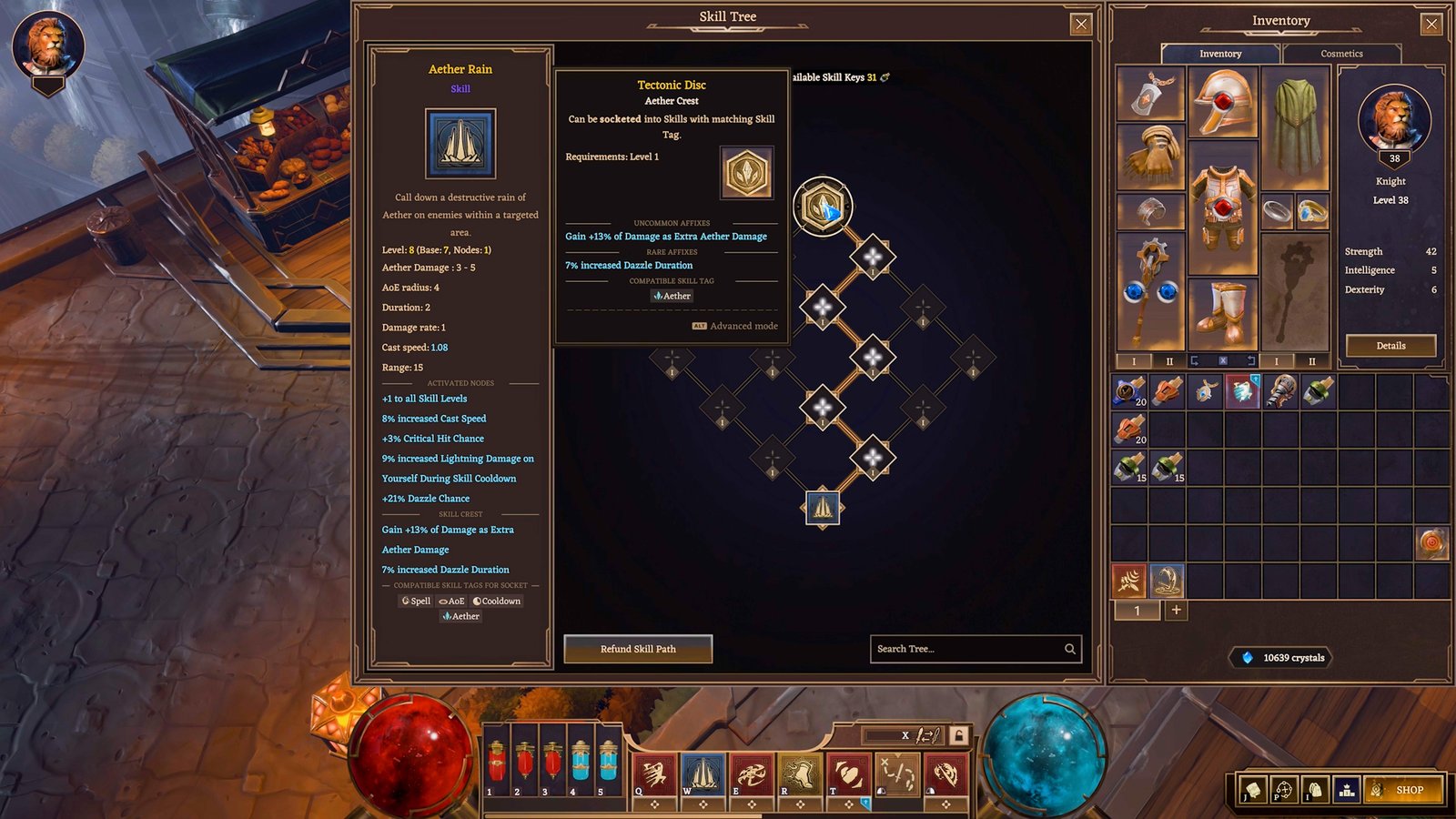
Larsson: We are very unique in terms of setting. We are also very unique with the itemizations as well. And we also have the core pillars of lootable skills with rarities that differentiates us. It’s a very unique take on the whole, like build your own character gameplay as well. It’s pretty advanced. There’s lots of stuff you can do. Me personally, I played 10, 15,000 hours of Path of Exile 1, and I’m sort of against this whole green arrow up, red arrow down.
I worked on Magicka 2 as well with the whole friendly fire thing. And I think players are pretty smart, they like to be smart. Crystalfall also does a lot of advanced stuff that gives players a lot of pieces of the puzzle. But it’s like if you put the puzzle piece and you just mash it into the wrong place, like that’s up to you. You can solve it in any way you want. We will, of course, guide you with the proper UX and whatnot. But in the end, it’s up to you. So we’re sort of leaning more into the sort of midway, I would say more advanced than Diablo 2, but less so than Path of Exile.
Also Read: Exclusive Interview: Planet of Lana II Devs Talk Returning to Lana’s World
How Crystalfall Handles Progression
TGS: The trailer mentions endless progression. What does that actually mean in Crystalfall, on a practical level?
”you’re not going to find the best items in the early game. To do that, you’re going to have to play harder content.”
Larsson: So like in any type of these games, the idea is that the game sort of starts when you finish the campaign. So if you want them to play for a lot of hours, we have an initial stab on our take of the end game, if you will, for early access. It’s in the initial stages, but we are going to build and expand upon this in every content update that we do. But it’s also like finding these items, like you’re not going to find the best items in the early game. To do that, you’re going to have to play harder content. Then you have like scaling up of mobs. You’re going to fight bosses on higher levels. You’re going to find unique items or build your own character, progress in the talent tree, unlock more points, do harder content.
Then its sort of like putting your build together, finishing all the pieces. It’s not something that you do in a day. It’s going to take you quite a while, although trading with other players can probably alleviate a bit of this. In the end, it’s you go out, kill monsters, find better and cooler stuff, progress your character, level up, right? And then on top of that you’ve got the complexity of procedural skills, socketables, item base types, alpha and omega fixes, like there’s a lot of pieces that you can put together to just progress your character.
TGS: We’ve spoken about the potential behind the endless progression element. What would you say has been the most difficult part of delivering that level of depth as an indie studio?
Larsson: I would say scale. It’s probably like just the amount of content I think that we are able to put out with all of our systems and just the sheer amount of content that we have in for early access. That’s pretty impressive. I would say it’s taken some time and like building custom tooling and a lot of head banging and talking with each other, just coming up with ideas. But there are a lot of interactive systems. It’s incredibly hard to balance these types of games. I’m just trying to fit the player progression with the talents, the items, the item affixes, the skills, the random skill nodes, the random skill generations, uniques, like it’s just so much things that need to fit together.
And that’s also why we’re doing early access, because there’s just so much content in the game that we need help finding all of these broken combos. Players are smart, they like breaking things, like finding OP combos. Then they hate the game designers when we sort of nerf them! I can sit and play this game for quite a while, but i would still find balancing problems that we need to bring in line.
Crystalfall’s Development Journey
TGS: When you started out looking at the Crystalfall roadmap, then in the reality of actually making the game, was there anything that you had to rethink or scale back on or even redesign entirely once the realities of development started setting in?
Larsson: So the original idea was that we were going to have unique talent trees for every single class. But then we sort of realised that adding, we have three classes now and we want to add more on top of that, adding just three with over a thousand talent nodes. It’s a lot of content for a small team. So, and it’s all like, there is a charm in having the class less, like you can progress into another person’s trees or like, you can do it with different solutions, but we sort of realised like, we sort of need to go back and like work with more polish and like getting the good stuff in and making sure it’s nice instead of quantity.
Eriksson: Also, one thing that can be mentioned, we were initially dabbling a bit in custom-made dungeons, like, but we decided rather quickly that we need to go the procedural route for replayability, but also for it’s, if you have that system, it’s faster to produce content. We are not Blizzard. We can’t build like they do.
How Crystalfall Keeps Things Fresh
TGS: How do you keep it fresh? How do you make sure that on hour 1 versus on hour 100, the player is having just as much fun?
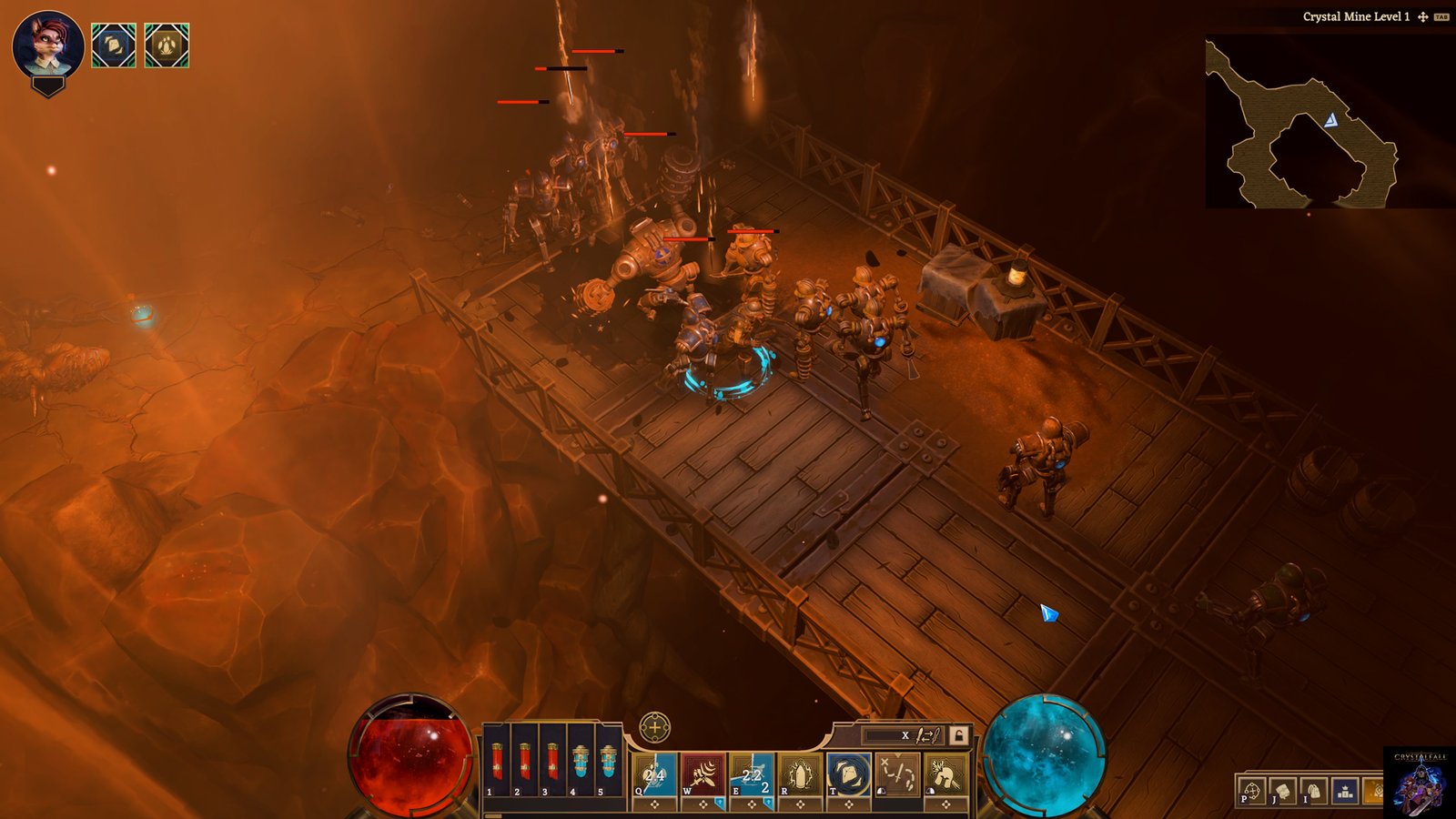
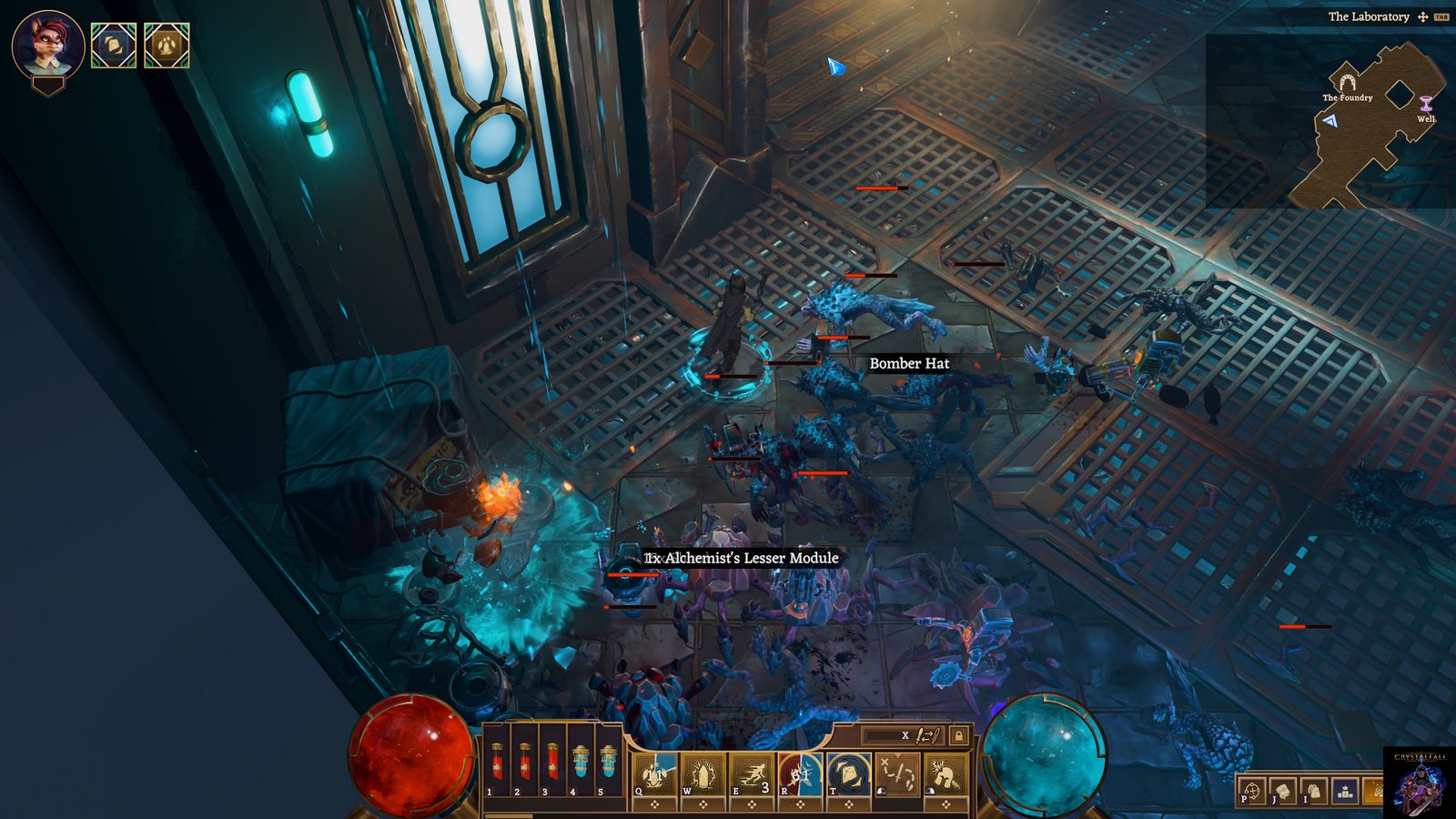
Larsson: It’s a very hard question to answer. I think it’s both with procedural content and overlapping content, it’s something that I talk about, like you have the talent trees, and you level up really quickly in the beginning. So you always get this next point to put somewhere and you can use it to specialise your character. But then on top of that, you find items and then you replace items, you can craft items. These change your character or enhance the character as well. And then on top of that, we also have the random skills that will also change things up. So there’s a lot of this layered progression that keeps the game interesting. There’s always something around the corner for you to strive towards. And then of course, the core game loop of building your character and becoming fast, killing a lot of monsters, having these juicy abilities, parts flying all over the place, robots falling down, stuff like that. Maybe making everything on the screen catch on fire with your pyro bullets or flaming shots!
It’s just satisfying in that sense, the core loop as well. In terms of having them play for thousands of hours, you of course need to have aspirational content. That feeds back into what I talked about earlier in having these things to always strive towards, making the content harder and then making the player solve how they want to complete it. Then in terms of keeping it fresh, we are also planning, for the eventual 1.0 to start our seasonal content. We’re having these short cycles where we add new mechanics, new items, new base types, new skills, new classes, revamps of the talent tree, stuff like that.
TGS: In terms of the Steampunk aesthetic, thats pretty rare in an ARPG. Does it factor into builds and systems or is it more of just a visual thing to aid the lore and setting?
Eriksson: It does factor into things like the flavour of items too, uniques and the names of affixes, the names of talents. We try to make it unified so everything kind of fits together. We might not be all there yet, but we are working on it.
Crystalfall Will Be Free-to-Play
”We are a new studio, this is our first game. We think we have a better chance of reaching a big audience if it’s free to play.”
TGS: The free to play element has pros and cons. What was the driving factor behind the decision to make it free to play?
Eriksson: We are a new studio, this is our first game. We think we have a better chance of reaching a big audience if it’s free to play.
TGS: How did you decide how to factor in monetization- is that going to be something that you think during early access, that model might change and evolve depending on player feedback?
Eriksson: We are looking at Path of Exile and how they do it, because it’s a similar game, similar genre. Monetization is a very interesting subject, but it’s also really hard to say that much before you’ve actually launched the game and see how it goes. There are so many models. You can look at Last Epoch for example. They sold the game, right? Premium. Then they offered content updates for free, but now they reversed on that and they are selling DLCs. But this is not out of greed. It’s because that original business model doesn’t work. At the end of the day, to run a live service game is expensive. It’s not easy to make ends meet.
How C.R.G Studio Will Gauge Success During Crystalfall’s Early Access Period
TGS: What would success for Crystalfall look like during the early access period?
Larsson: Most importantly we want people to enjoy the game. Then we want them to see its potential as well as enjoy it. We are building the base and the foundation of Crystalfall, which is also something that we are going to expand on. There are going to be kinks and issues, but underneath it all, I think we have a pretty good product players might enjoy for a very, very long time. Our target is to be one of the ARPG games in the ARPG player cycles between the Path of Exile 1 and Path of Exile 2, The Last Epoch and maybe Diablo 4- they are our target audience and success for us there would be for them to come back and play the game and enjoy it.
TGS: Will Crystalfall have difficulty settings?
Larsson: That’s a really good question. We talked about something that I call the ‘dodge roll’ games, the Souls games, right? In Path of Exile 2’s first iteration, your items got deleted if you killed the boss, but you died yourself, you lost all the items on the ground. We also have No Rest for the Wicked, which is an ARPG that’s taken off quite well, but I would say we sort of fit more into the POE 1 and Diablo 2 side here, which is your items and builds and character probably matters more than maybe your positioning. It’s still going to be a lot of skill, mechanically, for the player, but you also need to have items and talents that sort of mitigate whatever comes your way. In terms of bosses, of course, we have bosses in the game, but it’s not going to be these sort of Dark Souls boss fights in that sense.
Eriksson: This touches upon an earlier question, like what we are doing a bit differently. We decided to not do WASD movement for this reason, because we feel that this game is predominantly about the loot and the build. It’s not about the movement skill and I feel the more you lean into combat and movement, the less it’s about the loot, plus to get this WASD to feel really good, it’s not trivial, it’s probably a triple A budget kind of thing, like Path of Exile 2. They didn’t just pull it out of a hat! A lot of money burnt on getting that right.
TGS: If there are fans of isometric ARPGs that are on the fence about Crystalfall, what would you say will be the deciding factor to pique their interest?
”The excitement over finding loot, we aim to beat Diablo 2 in that respect!”
Larsson: I’m going to counter with, if you like ARPGs, this is going to be free to play. You should definitely try it out, give it a try and see if you enjoy it, if you think it has potential. I think its important that players try it out fairly for themselves and see what they think, its free to play afterall! Getting to try it out for themselves, that I think is step one. Then I would say, touching back on what we talked about already, hitting these content updates, just improving the game, showing where we want it to be continuously, I would say is also a deciding factor.
Eriksson: One more thing. The excitement over finding loot, we aim to beat Diablo 2 in this respect!
[End of interview]
C.R.G Studio’s passion for their maiden project was evident throughout the interview. With the studio opting for Crystalfall to be free-to-play, it feels like a no-brainer for anyone with a passing interest in isometric ARPGs to give it a go when it launches in March. A demo is also available right now via Steam.
