


First of all, a shoutout to the Gaijin community manager reading this. It has become an international time-honoured tradition for sensitive military info to see the light of day on War Thunder, and the military of the People’s Republic of China is no stranger to this. However, this one time, it’s not War Thunder we are talking about.
In a surprising twist, despite the country’s reputation for being cagey around all military affairs, the Chinese government has seemingly greenlit a full-depth simulation of its first BVR-capable domestic fighter jet.
Developer Deka Ironwork Simluations (DIS) has confirmed on Bilibili that it is now working on a full fidelity version of the Shenyang J-8DF interceptor for DCS World. Previously, DIS had been working on the J-8II Peace Pearl, but the work will now carry over to the J-8DF variant.
The initial choice to model the Peace Pearl J-8 variant, part of the Peace Pearl program, had been a topic of heated discussion in simulation circles. This Sino-American collaboration would incorporate off-the-shelf American equipment into the J-8B airframe, but the program was cancelled shortly after its inception due to cost overruns and political tensions.
Some simmers believed the addition of any Chinese fighter was better than no model at all, but others argued that Peace Pearl was unfit for DCS World given that it never made it past the prototype stage. Now, it seems, everyone is happy.
A New Government Gaming Offensive
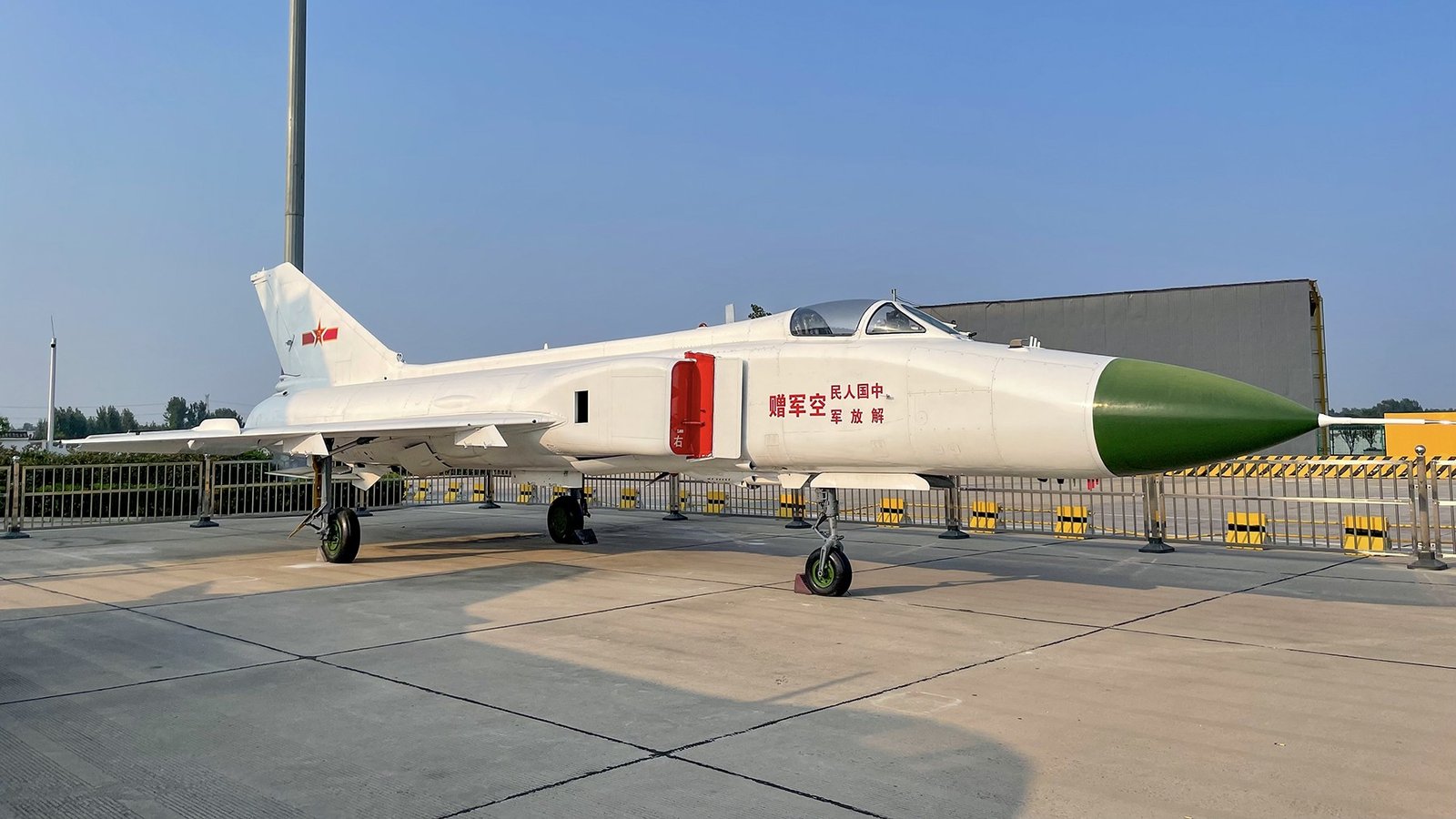
The new variant, advertised by DIS as the J-8DF. Introduced in the early 2000s, the J-8DF features a glass cockpit, and it is built around the Type 1492 Pulse-Doppler radar. Performance specifics are scarce, but commonly accepted estimates put its search performance around 80km for a fighter-sized target (frontal radar cross section around 3m²).
Although somewhat inferior than contemporary Western and Russian radars, it allows the J-8DF to fire the PL-12 active radar-guided missile. The lack of a continuous-wave (CW) antenna precludes it from firing the older PL-11 semi-active radar-homing model developed from the Italian Aspide missile.
The Chinese air force has retired the last of its J-8 interceptors in October 2024, leaving only the reconnaissance JZ-8F in service. The type’s withdrawal certainly helps access for entertainment purposes, but this is far from a given.
Although somewhat inferior than contemporary Western and Russian radars, it allows the J-8DF to fire the PL-12 active radar-guided missile.
Previously, multiple flight simulator developers have ran into trouble due to red tape from defense ministries around the world, but it seems many government agencies are finding value in supporting (or at the very least not actively opposing) the inclusion of its modern aircraft in videogames.
During the yearly DCS World showcase, third-party studio Heatblur Simulations unveiled it was working on the Dassault Rafale C multirole fighter. Around this time, Eagle Dynamics announced plans to bring the Lockheed Martin F-35A stealth jet to the game.
Until recently, simulating the active backbone of any air force was seen as unthinkable, and there is precedent of governments actively curtailing such plans.
There is still a long way to go for the J-8DF, the Rafale C, or the F-35A to see the light of day in DCS World. However, even while still in development, these projects mark a paradigm shift where modern does not automatically mean unavailable, and the flight simulation community can only benefit from that.
Set TheGameSlayer as your Preferred Source on Google to find us more easily in your searches for game guides, news, reviews and features!
