


Hyungjun “Kjun” Kim is the lead behind inZOI, and for someone with a very personal connection to the life sim genre, his answer to the classic question of “would you do it all again?” is not what you’d expect from most devs.
For most passionate devs, even if their project wasn’t all that successful, they’d have very few regrets about running the gauntlet in the first place. The inZOI lead, though, has another perspective.
“Life sim games are difficult to master,” Kim told IGN in a Q&A session. “If you asked me if I would turn back time and make it again, I think I would hesitate.”

Kim is not lacking in personal drive nor ambition. And while he knew it would be hard to make something that can compete with the genre heavyweight of The Sims, even he underestimated the full scope of the challenge.
“The Sims 3 was open-world, and The Sims 4 moved to a more loading-based. I understand why they did that,” Kim said. inZOI tackled the genre from that open world direction, taking a route that EA had already stepped away from. Very quickly, he learned the weight of that move.
“There may not be any other team that attempts to make an open-world life-sim game.”
“To put it simply,” Kim continued, “I’ve been doing this for about 29 years now. I’ve been making games for a very long time, but after trying it out, I realised that I couldn’t do it properly. It was too much.”
This difficulty didn’t just make life harder for the devs – it also put a burden on the players.
InZOI is not the sort of game you can run on a potato. You need good hardware to handle what the game offers, and that meant beefing up the demo to intentionally dissuade certain buyers. “We released a demo was that, well, it didn’t really fit the specs. We actually did it to prevent people who didn’t quite fit the game from making the wrong purchase.”
InZOI Playtesting Had To Be Public – Which Forced Early Access
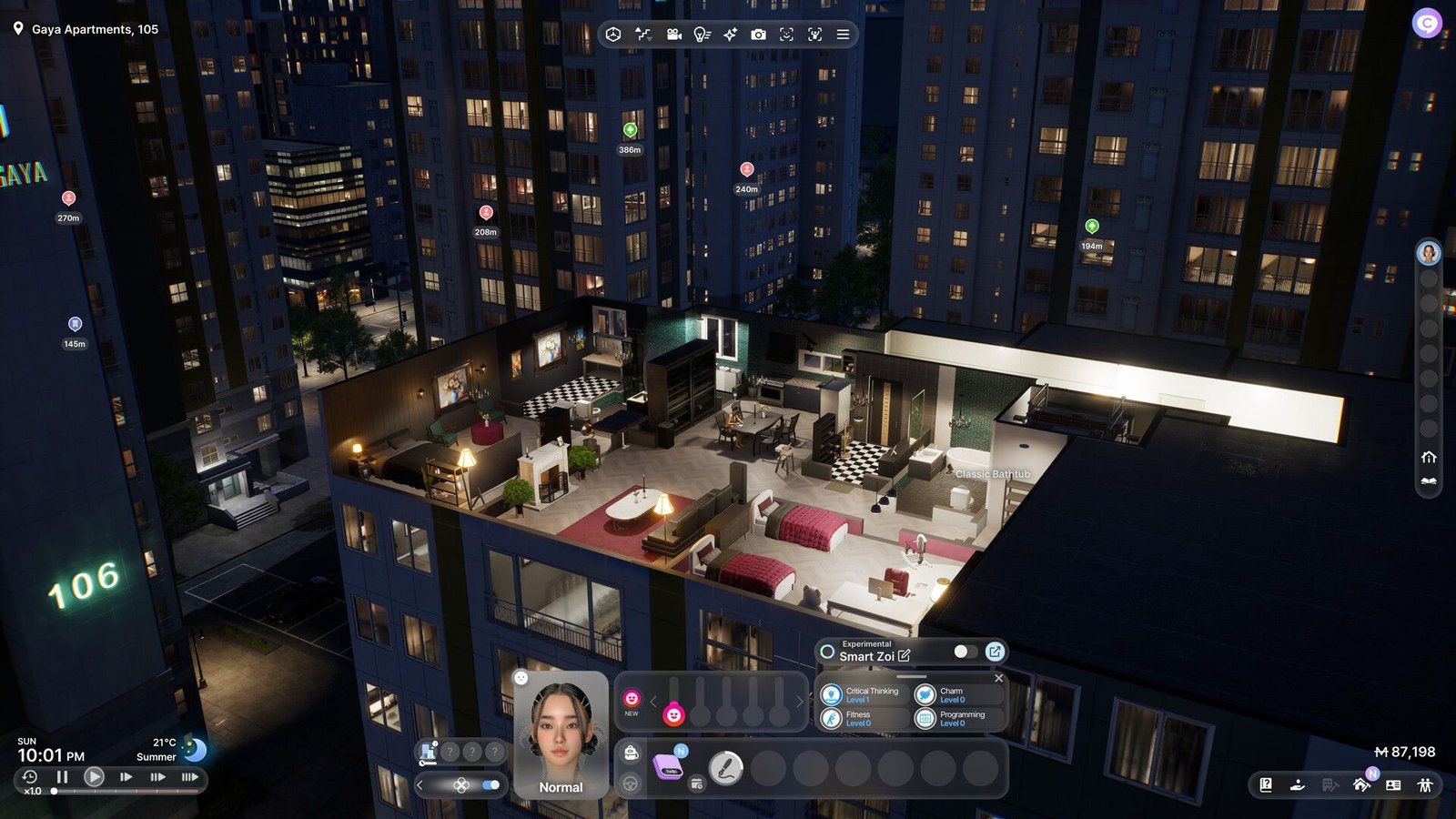
According to Hyungjun Kim, inZOI couldn’t be properly playtested until it got into the hands of the public. Which meant players would see everything mid-development – the sweet, and the sour.
“The reason we had to use early access is that we cannot see the results ourselves. So we had no choice but to use early access. The users are testing it on our behalf, so I always feel sorry for them.”
“When it was released to customers, there were many shortcomings in the game running as a complete game.”
The upside to all this is that inZOI – a game about user-created experiences – would get all the authentic player data they could ever need. What did they get out of it? A game with decent reviews (78% positive on Steam) and a concurrent player base that’s reliably hovering in the low 4-digits. Not a failure by any stretch of the imagination, though InZOI and Krafton almost certainly had higher hopes.
“Do I really have to make a lot of money?” Kim wondered. “Isn’t that how a company is? It seems to have diverse futures. Even if some people make a lot of money, others might be presenting possibilities regarding the future of games. Who knows, maybe later on, the future of the entire game industry?”
